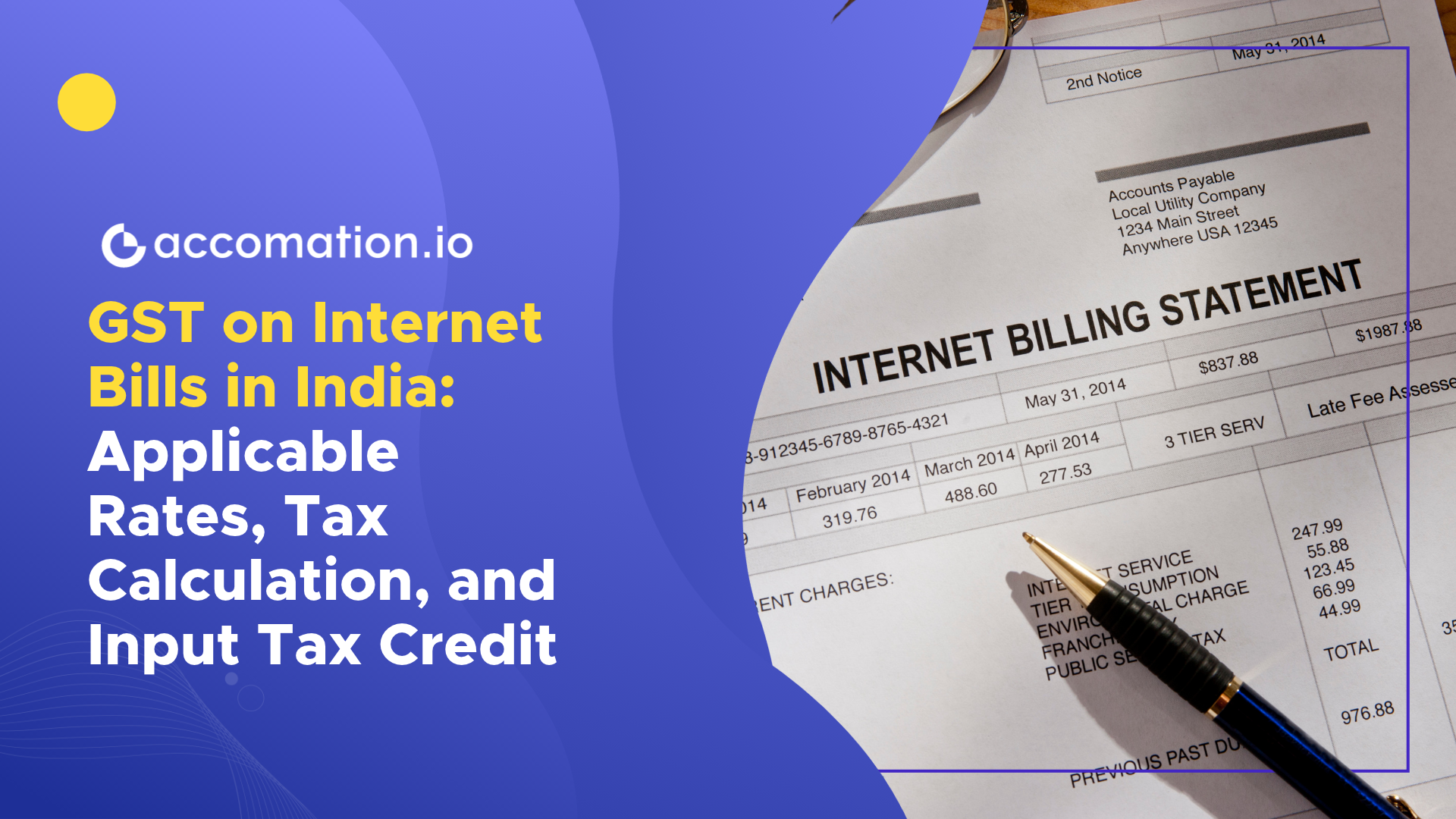
Unlike a few household bills that stay outside the tax net, your internet connection sits firmly inside it. Every broadband, fibre or Wi-Fi plan in India carries GST, and if you run a business, there's a good chance you can claim some of it back. Here's a straightforward look at GST on internet bill charges, especially the rate, how it's worked out, and who can recover it.
What is the GST rate on internet bills?
Internet is taxed at a flat 18%. Whether it's home broadband, an office fibre line or a mobile data plan, the GST on internet services is the same 18% across the board. The GST rate on internet services doesn't change with your provider or your city. Whether it is Jio, Airtel, BSNL or a local ISP, the figure is identical. The GST on broadband bill you receive at home works out the same way as a company's, and a GST on Wi-Fi bill for a hotspot or wireless plan is treated no differently.
This rate has held steady since GST began in 2017, and even the big rate changes of September 2025 left it untouched, so GST on broadband services in India remains 18% in 2026. Internet sits under the telecommunications services group (SAC code 9984), which keeps all these connections on the same slab.
How the tax is calculated
Working out the tax is simple once you know it's 18%. Take your plan amount, add 18%, and that's your total. On a ₹1,000 broadband plan, the GST is ₹180, making the bill ₹1,180. On a ₹700 plan it's ₹126, and so on. On most bills that 18% is split into two halves, 9% CGST and 9% SGST, because your provider and your connection are usually in the same state. Only when they sit in different states does it show as a single 18% IGST line, which is rare for home internet. So, the whole of internet bill GST calculation comes down to one step: eighteen percent of the plan value, shown as two 9% lines on your invoice.
Can businesses claim it back?
This is the part worth paying attention to. Because internet is a taxable service, a GST-registered business can claim the tax it pays as input tax credit, something you can't do with an exempt bill like electricity. If your company pays for a broadband or leased line used for work, the 18% on it can be set off against the GST you collect on your own sales. Claiming input tax credit on internet bill charges does come with conditions, though. The connection must be used for business, and this is the one people miss, the bill must carry your business's GSTIN, not your personal name. A home connection billed to you as an individual won't qualify. Get the invoice in the company's name, with its GSTIN, and that monthly 18% stops being a cost and becomes a credit.
It's not only fixed broadband that qualifies, either. Mobile data, including prepaid recharges and postpaid plans, carries the same 18%, and that tax is just as claimable when the number is used for business and billed to the company. For a team that runs on mobile connections and data cards, those monthly recharges add up to a meaningful credit over a year, so they're worth capturing rather than writing off as a small expense.
What a proper GST invoice should have
To claim that credit, the bill must be a proper tax invoice and not just a payment receipt. A valid GST invoice for internet services should show the provider's name and GSTIN, your business name and GSTIN, the plan or service description with its SAC code, the taxable amount, and the GST split out as CGST and SGST (or IGST). If any of those are missing, especially your GSTIN, your accountant can't claim the credit, so it's worth checking the first bill after you set up a business connection and asking the provider to correct the details if needed.
Keeping internet bills in your books
Internet bills arrive every month, often across several connections or branches, and each one needs to be recorded and matched for the credit to land. Doing that by hand is easy to fall behind on. This is where invoice automation for internet bills helps, it can read each bill, capture the amount, GST and SAC details, and file them into your accounts, so nothing slips through and your credit claims stay clean.
The bottom line
The short version on GST on internet bill charges: it's 18%, it applies to every kind of connection, and on most bills, it's split as 9% CGST and 9% SGST. The difference from other utilities is that businesses can claim it back, if the bill is in the company's name with its GSTIN. Get that right, and your internet tax starts working in your favour.
 Recent blogs