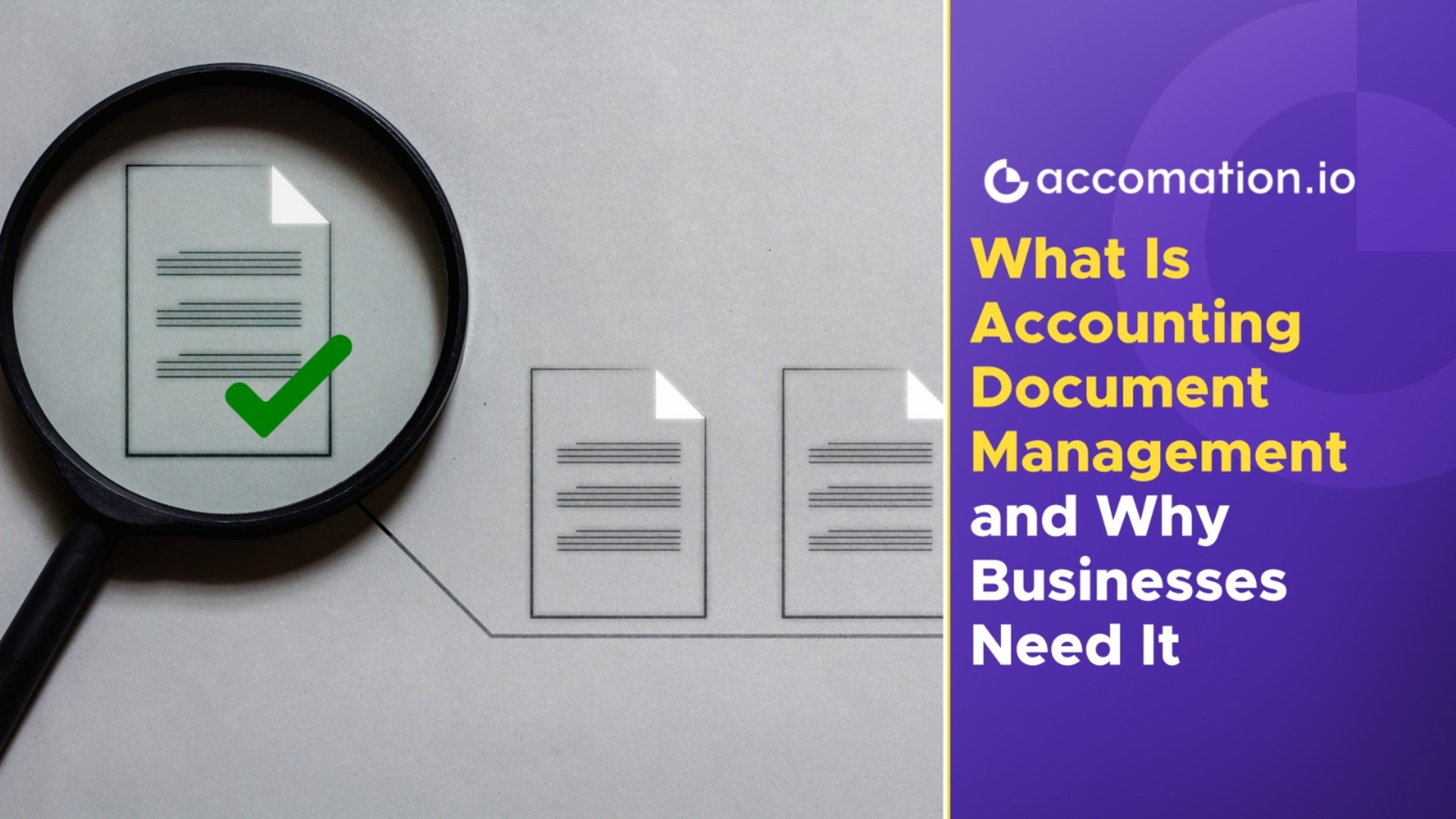
Every business these days deals with invoices, purchase orders, receipts, bank statements, tax documents, financial reports, and whatnot. Managing these files manually becomes difficult as the business grows. Accounting Document Management is the process of storing, organizing, searching, and managing financial documents digitally, making them easy to access while improving accuracy, compliance, and overall efficiency.
What Is Accounting Document Management?
An accounting document management system is a centralized platform that stores all accounting and financial documents in one secure location. Unlike basic cloud storage, it uses AI to extract information from documents, indexes them using relevant accounting fields, and makes them searchable within just a few seconds.
Instead of digging through folders or naming files manually, finance teams can locate documents using invoice numbers, vendor names, GSTIN, dates, transaction amounts, or other business-specific parameters.
Modern accounting document management software also integrates with accounting systems, allowing documents to become part of the accounting workflow instead of remaining isolated files.
Why Businesses Need Accounting Document Management
Accounting teams process hundreds or even thousands of documents every month. Invoices arrive through emails, receipts are scanned from mobile devices, bank statements are downloaded from multiple banks, and tax-related documents continue to grow over time.
Without a structured system, finding a single document can take several minutes. Multiply that across an entire finance team, and the productivity loss becomes significant.
A well-designed document management for accountants' solution eliminates these inefficiencies by ensuring every document is securely stored, properly categorized, and instantly searchable.
It also improves accounting records management by maintaining a consistent digital record of financial documents throughout their lifecycle. This not only saves time but also simplifies audits, tax filing, and internal reviews.
How an Accounting Document Management System Works
Modern document management platforms go far beyond storing PDFs.
A typical workflow looks like this:
Documents are uploaded through email, scans, or digital imports.
AI and OCR automatically extract important information such as vendor names, invoice numbers, dates, GST details, and transaction values.
The extracted data is indexed, making every document searchable using multiple parameters.
Documents are securely stored in the cloud with version history and audit trails.
The system integrates with accounting software, so documents remain connected to accounting entries and business workflows.
This combination of AI, automation, and cloud storage transforms traditional financial document management into an intelligent business process rather than a digital filing cabinet.
Key Benefits of Accounting Document Management
Implementing an accounting document management solution delivers advantages across the finance function.
Faster document retrieval
Searching by vendor, invoice number, amount, or GSTIN is significantly faster than manually browsing folders.
Improved accuracy
AI-based extraction reduces manual data entry, minimizing typing errors and duplicate records.
Better compliance
Digital records are easier to maintain for statutory audits, GST filings, and financial reporting.
Higher productivity
Finance professionals spend less time searching for files and more time reviewing financial information and making business decisions.
Supports automation
When documents are organized and digitized, businesses can implement broader accounting workflow automation, reducing repetitive manual tasks across accounting operations.
Essential Features to Look For
Not every solution offers the same capabilities. When evaluating an accounting document management platform, businesses should look for features that improve both accessibility and operational efficiency.
Feature | Why It Matters |
AI-powered data extraction | Eliminates manual data entry from invoices and financial documents. |
Advanced search | Finds documents using invoice numbers, vendor names, GSTIN, dates, or amounts. |
Cloud-based storage | Enables secure access from anywhere while reducing dependency on local systems. |
Accounting software integration | Connects documents directly with accounting records and workflows. |
Version history and audit trails | Maintains transparency and supports compliance requirements. |
Secure access controls | Protects confidential financial information while ensuring authorized access. |
These capabilities make accounting document storage far more effective than simply uploading files into shared folders.
Accounting Document Management vs Traditional File Storage
Many businesses assume cloud drives are enough to manage accounting documents. While they provide storage, they are not designed for accounting operations.
Traditional File Storage | Accounting Document Management |
Manual folder organization | AI-powered indexing and categorization |
Search by filename only | Search using accounting data like GSTIN, vendor, invoice number, or amount |
Separate from accounting processes | Integrated with accounting software |
Limited automation | Supports AI extraction and workflow automation |
Basic storage | Intelligent document lifecycle management |
The difference becomes even more noticeable as businesses grow. Maintaining digital accounting records through a dedicated document management platform improves efficiency while reducing the administrative effort required to manage financial information.
Which Businesses Benefit the Most?
Almost every organization that handles financial documents can benefit from better document management.
Some of the biggest beneficiaries include:
Accounting and CA firms managing documents for multiple clients.
Manufacturing businesses processing large volumes of supplier invoices.
Retail businesses handling invoices, purchase orders, and GST records.
Healthcare organizations managing vendor payments and financial documentation.
Professional service firms maintaining contracts, bills, and expense records.
For firms handling documents across multiple clients, document management software for accounting firms helps standardize processes while improving accessibility and compliance.
Similarly, businesses dealing with thousands of financial documents every year benefit from structured accounting file management, making information easier to retrieve whenever required.
Final Thoughts
Managing accounting documents shouldn't involve searching through endless folders, downloading duplicate files, or manually entering information into accounting systems.
Modern Accounting Document Management combines AI-powered data extraction, intelligent search, cloud storage, audit trails, and accounting software integration into a single workflow. It helps finance teams reduce manual effort, improve accuracy, and maintain complete control over their financial records.
If your business is looking to simplify document handling while automating repetitive accounting processes, Accomation.io's AI-powered Document Management solution can help you organize, search, and process financial documents faster—allowing your team to focus on accounting, not paperwork.
Final Thoughts
Modern Accounting Document Management combines AI-powered extraction, intelligent search, cloud storage, audit trails, and accounting software integration into one workflow. If your business is looking to simplify document handling and automate repetitive accounting processes, Accomation.io's AI-powered Document Management solution can help organize, search, and process financial documents faster.
 Recent blogs