Many businesses still spend hours manually entering data from invoices, receipts, and bank statements into spreadsheets or accounting software. Data entry automation simplifies this pre-accounting process by automating document processing and financial data extraction, reducing manual effort, improving accuracy, and streamlining accounting workflows.
But the phrase gets thrown around a lot. Some people think it simply means scanning documents. Others assume it means AI replacing their accounting team. Neither is accurate. So before talking about tools or platforms, it’s important to answer a simple question: what is data entry automation?
Data Entry Automation: Explained
When you use software to capture, extract, and structure information automatically without having to have someone type it manually, it is called data entry automation.
Think about how data usually enters a system. An employee opens a document. They read the details. Then they type those details into another system. That process is manual data entry.
With automated data entry, software reads the document, identifies key fields, and prepares that data in a structured format. Instead of typing information, employees simply review and approve it. For most organisations, data entry automation for businesses focuses on documents like:
Vendor invoices
Expense receipts
Bank statements
Purchase orders
Financial documents used in accounting
The goal isn’t to remove people entirely. The goal is to remove repetitive typing.
Why Businesses Are Moving Toward Automation
Manual entry might seem manageable when transaction volume is small. But as a company grows, the workload increases quickly.
Teams start facing three common problems:
First, mistakes increase. Typing hundreds of invoices a week inevitably leads to errors. Businesses often adopt business data entry automation specifically to reduce manual data entry errors.
Second, time gets wasted. Skilled finance teams end up spending hours on mechanical work instead of analysis or decision-making.
And third, workflows become fragmented. Documents arrive through emails, messaging apps, and uploads. Without a structured system, managing them becomes messy.
These are some of the practical benefits of data entry automation. The technology doesn’t just speed up typing. It organizes how information enters your business systems.
How Data Entry Automation Works
To understand how data entry automation works, it helps to look at the underlying technologies. Most modern data entry automation tools rely on a mix of document recognition and automation frameworks.
One important thing is OCR data extraction, which means optical character recognition. It allows software to read text from a scanned document or images with data in them. However, reading text alone is never enough. The system should be smart enough to understand what each text represents as well.
This is where AI data entry automation comes into play. AI models can smartly recognise patterns across different invoice formats and identity fields like vendor names, dates, totals, tax details, and much more. The result that you get is intelligent data capture, where your documents are converted into structured data, which you can process with ease.
Some platforms even offer automated data validation. The system checks whether extracted values make sense before sending them to the next stage of processing.
All of this often runs in a cloud environment. That’s why many modern solutions operate as cloud data automation platforms, allowing teams to access and process documents from anywhere.
A Typical Data Entry Automation Workflow
The real value becomes clear when you look at the data entry automation workflow.
Let’s talk about an automated setup where documents enter the system through uploads, emails, etc. Once you feed in the raw document, OCR data extraction reads the document. Then, AI models interpret their structure to capture relevant fields. Finally, the data is exported to your relevant system.
This entire data entry automation workflow removes multiple manual steps. Instead of typing everything into accounting software, employees review structured information and confirm it. In many organisations, this workflow also connects with business process automation. That means extracted data can trigger approvals, accounting entries, or reconciliation processes automatically.
Common Use Cases in Businesses
There are several practical data entry automation use cases across departments. In finance teams, automation helps process invoices, expenses, and bank statements.
You will find many practical data entry automation use cases across departments in various firms. Finance teams use automation to process invoices, expenses, bank statements, etc. The operations team uses it for POs and supplier docs. Customer service teams use it for form processing and onboarding, and so on, and so forth. These use cases show why data entry automation for businesses has become part of a larger digital transformation effort. It’s not just about speed. It’s about consistency.
Choosing the Right Automation Software
When you are searching for the best data entry automation software, you must understand that some tools only extract text from documents. Others provide a more complete system that includes validation, integrations, and workflow management.
Businesses evaluating data entry automation solutions for SMB should consider a few practical factors:
How accurately the system reads different document formats.
Whether it includes validation checks to prevent incorrect entries.
How easily it integrates with accounting or ERP software.
And whether it supports growing transaction volumes.
These considerations are part of a broader data entry automation implementation strategy.
Understanding the ROI of Automation
Before adopting automation, many leaders ask about the ROI of data entry automation. The return usually comes from three areas.
First, time savings. Employees spend less time entering data manually.
Second, accuracy improvements.
Third, operational efficiency.
This helps you understand why data entry automation solutions for SMB are becoming common across all the growing businesses across the country.
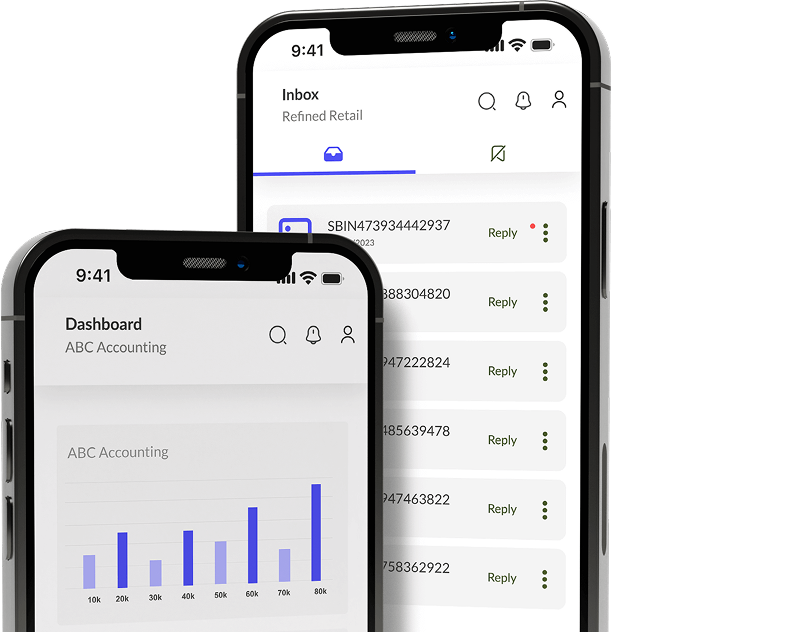
For businesses dealing with large volumes of documents, tools like Accomation.io show how data entry automation tools can simplify financial processing and improve overall efficiency.
 Recent blogs