If you are a business owner in India, you must have surely come across the term ‘e-invoicing’. And you would have thought if it even applies to you or not. The confusion is fair. The rules have shifted a few times since 2020, and the turnover figure that decides who's in and who's out keeps moving lower.
So, let's clear it up. Here's exactly what the e invoice limit in GST looks like in 2026, who has to follow it, who doesn't, and why it matters for the way you keep your books.
What is the e-invoice limit in GST in 2026?
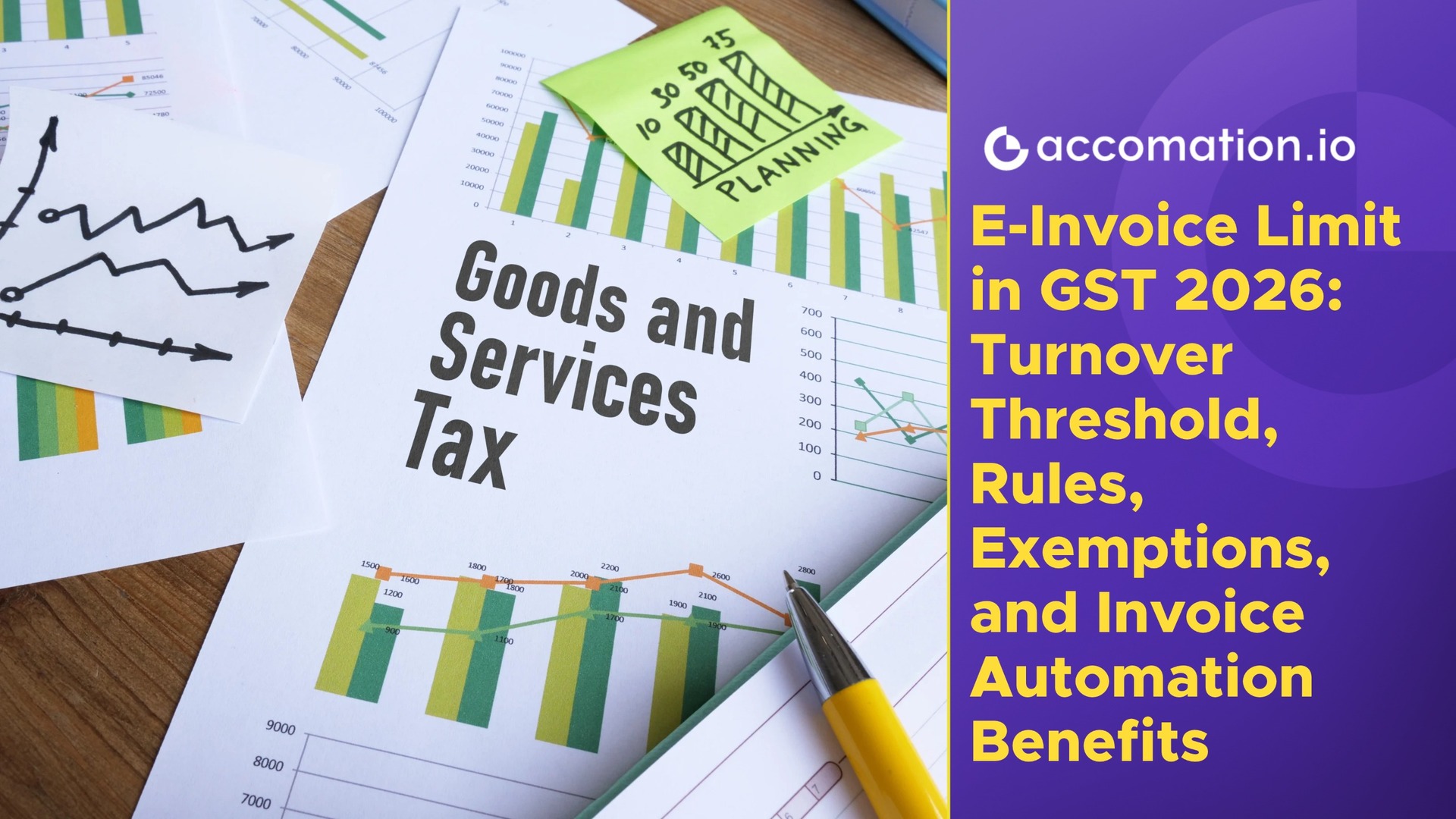
As of 2026, the GST e-invoice turnover limit is ₹5 crore. In simple terms, if your business crossed ₹5 crore in total annual turnover in any of the financial year since the 2017-18 cycle, you are expected to generate e-invoices in your business. That is what the current e-invoice limit under GST is, and it has stayed the same i.e. ₹5 crore since August 2023.
A couple of things worth knowing. This e-invoice threshold limit is counted across your PAN, not each GST number separately. So if you operate in more than one state, you add it all up. And once you've crossed the line, you stay in the system; even if your turnover dips below ₹5 crore the following year, the rule still applies. The GST e-invoice limit in India has only ever moved in one direction: down. It began at ₹500 crore in 2020 and has been pulled lower in stages to bring smaller businesses in.
Who is required to generate e-invoices under GST?
Here's the simplest way to think about GST e-invoicing applicability. If your turnover is above ₹5 crore, e-invoicing applies to your business-to-business sales, that means supplies to other registered businesses, exports, and sales to SEZ units. It also covers the credit notes and debit notes on those transactions.
What it does not cover is your B2C sales. If you're selling directly to everyday customers, those bills don't need an e-invoice. So, the real answer to who is required to generate e-invoices under GST comes down to two things: your turnover, and whether you're selling to other businesses.
GST e-invoice rules 2026: how it actually works
The mechanics are less scary than they sound. Instead of printing an invoice straight from your software, you first send the invoice details to the government's Invoice Registration Portal. The portal checks it, stamps it with a unique number (the IRN) and a QR code, and sends it back. Only then is it a valid invoice.
That single step is the heart of the GST e-invoice rules 2026. If an invoice doesn't carry a valid IRN, the law doesn't treat it as an invoice at all. And that means your buyer can lose their input tax credit on it, and you can land a penalty. There's also a timing rule for larger businesses: if your turnover is ₹10 crore or more, you must upload each invoice to the portal within 30 days of its date. Wait longer and the portal simply won't accept it.
Who is exempt from e-invoicing?
Not everyone above the threshold must comply. Some kinds of businesses are kept out of the system no matter how much they earn. This is where the GST e-invoice exemption limit gets misread. It isn't really a turnover number; it's about what kind of business you are. The exempt categories include:
● Banks, NBFCs and other financial institutions
● Insurance companies
● Goods transport agencies
● Passenger transport services
● Cinema and multiplex operators
● SEZ units (though SEZ developers are not exempt)
● Government departments and local authorities
If you fall into one of these groups, e-invoicing doesn't apply to you even if your turnover is well past ₹5 crore. Everyone else above the limit is in.
Where invoice automation fits in
Here's the part most compliance articles skip. Generating e-invoices is only half the job. Every invoice you raise, and every invoice your vendors send you, still must be recorded in your books. For a growing business, that's a mountain of data entry, and doing it by hand is slow and easy to get wrong.
This is where invoice automation earns its place. Instead of typing every bill into your accounting system line by line, good invoice automation software for GST e-invoicing reads your invoices, pulls out the details, and files them into your books for you. It doesn't replace the government portal, it handles everything around it, so compliance stops eating your team's week.
The bottom line
The e invoice limit in GST in 2026 is simple at its core: above ₹5 crore in turnover, on B2B sales, with a short list of exempt businesses. Know where you stand, keep your invoicing clean, and lean on automation for the repetitive parts. Get those three right and e-invoicing turns into just another routine and not a headache.
 Recent blogs